
Volume 3, Issue 1 | March 4th, 2026
Mayor’s Connection Report
March 3rd, 2026
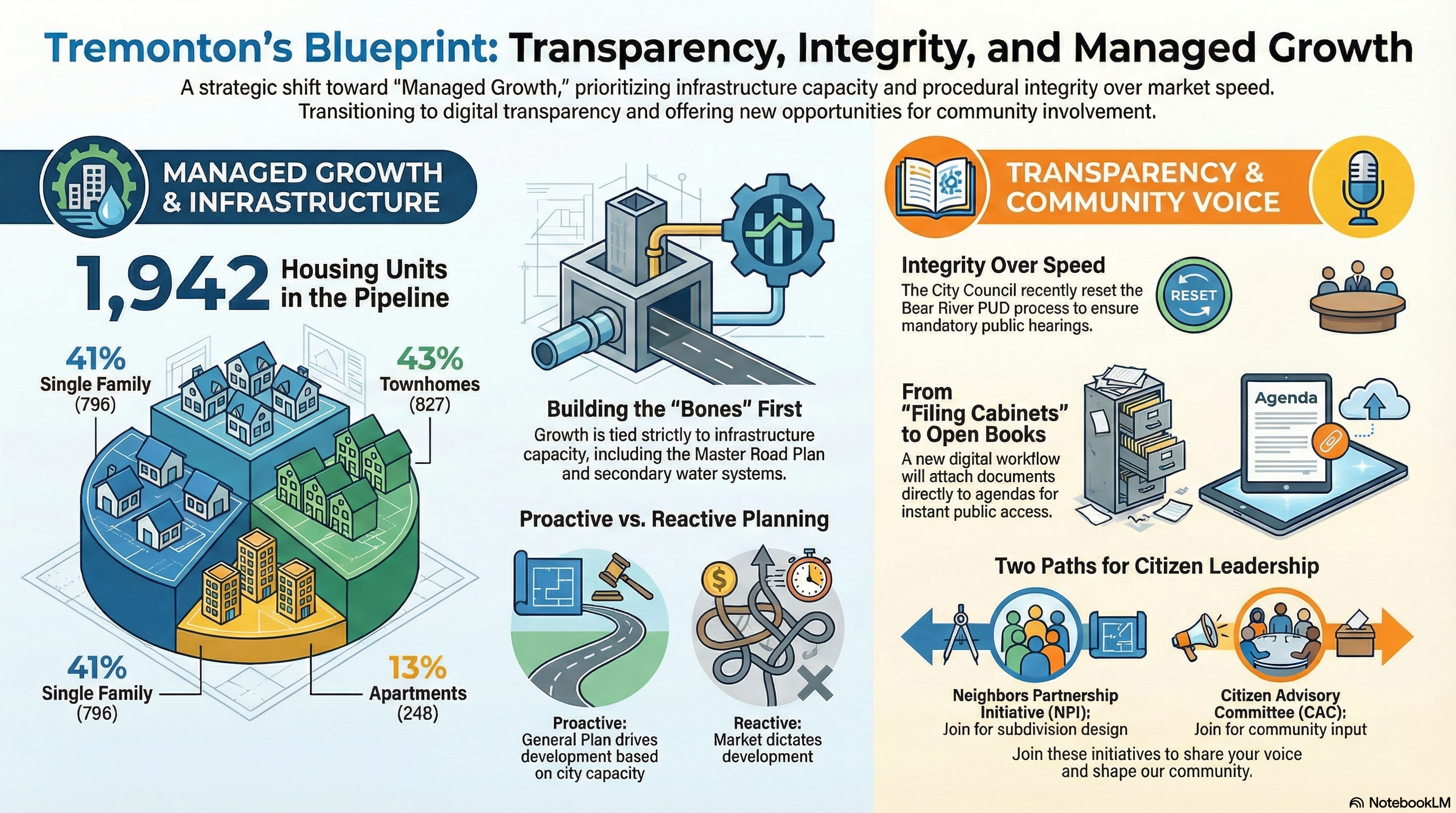
One of our residents made a great point last night: it’s too hard to find the documents you need to stay informed. I’ve said before that we need to move away from “Radar O’Reilly” filing systems. We’re working on a new website and a digital workflow that will attach documents directly to agendas so you can see exactly what we see. Transparency isn’t just about being honest; it’s about being accessible.
The Process Fix: Doing It Right
Last night, the Council voted to repeal a previous decision on the Bear River Valley PUD. We realized the full due process—specifically the public hearing—hadn’t been completed as required. In Tremonton, we don’t take shortcuts. We are hitting the reset button because the integrity of our process is more important than the speed of an approval. This is how we ensure every resident has their say and every decision stands on solid ground.
Growth: The Source of Truth
According to the developers’ current plans, we have 1,942 units in approved housing developments. Here is what that mix looks like:
- Single Family Homes: 41% (796 units)
- Townhomes: 43% (827 units)
- Apartments: 13% (248 units)

This shows exactly why a new General Plan is so vital. Right now, these numbers are driven by what developers think the market wants. Without an updated plan, the city is stuck in reactive mode. Our new General Plan is the tool that lets us drive these percentages based on our infrastructure capacity—our water, sewer, and roads—rather than just letting the market dictate our future.
What “1,942 Approved Units” Actually Means
Let’s clear something up. “Approved” does not mean:
- They’ll all be built.
- They’ll be built quickly.
- They’ll all be occupied at once.
Typically, Developers build over 10 to 30+ years depending on market demand, interest rates, local jobs, and infrastructure capacity. Honestly, some developments never get fully built.
The real question is: How many people per unit? The key variable is average household size. Typical U.S. averages are roughly 1.8–2.2 people for apartments, and 2.5–3.3 people for single-family homes.
Here are three scenarios for what those 1,942 units mean for our current population of 12,677:
| Scenario | People per Unit | Added Population | New Total | % Growth |
| Conservative | 1.8 | ~3,495 | ~16,172 | +27% |
| Moderate | 2.5 | ~4,855 | ~17,532 | +38% |
| High-Family | 3.3 | ~6,408 | ~19,085 | +50% |
What Growth Has Looked Like
Over the past 5 Fiscel Years (Tremonton City FY is July 1 – June 30) growth can be seen below from the amount of building permits offered and dwelling units built from those permits.
| Year | Building Permits | Dwelling Units |
| ‘20-’21FY | 138 | 208 |
| ’21-’22 FY | 135 | 313 |
| ’22-’23 FY | 37 | 88 |
| ’23-’24 FY | 57 | 116 |
| ’24-’25 FY | 66 | 100 |
The Covid Boom
The covid boom from 2020 – 2022 fits a pattern that happened across much of the United States during the COVID-19 pandemic. Several economic and social forces all hit at the same time, which caused unusually strong housing growth in smaller communities like Tremonton.
Some of these social forces included Record-Low Interest Rates where mortgage rates dropped to around 2.5–3%, the lowest in modern history. COVID caused a massive shift to remote work and allowed people to move to a more desirable location without the need to commute while still keeping their jobs. Our location near the junction of Interstate 15 and Interstate 84 made it attractive for commuters and developers.
Even before COVID, Utah had one of the fastest-growing populations in the United States due to High birth rates, Strong job growth, Migration from other states. Utah’s housing supply was already behind demand and when pandemic demand surged, builders rushed to construct homes, building permits spiked, new subdivisions appeared quickly.
The Covid housing boom translated directly into population growth. Our population was around 9,894 in 2020 and is estimated 12,677 in 2024. That represents about 28% growth in four years, extremely fast for a small city. Between 2020 and 2023 alone, Tremonton gained over 2,400 residents, making it one of the fastest-growing communities in northern Utah.
But as you can see in the table, After mid-2022 the housing surge slowed to a steady manageable growth. This cooling off happened for several reasons. Interest Rates Rose where mortgage rates climbed above 6–7%, which dramatically reduced affordability. Construction Costs Increased with prices for materials and labor rose during and after the pandemic and Market Correction where many homes had already been built during the boom, so demand cooled.
The Timeline Reality
Housing is rarely built all at once. Cities our size usually see 75–150 units built per year during steady growth, or up to 250 or 300 units for us at our height. But when things cool off, it’s much slower.
- Over 30 years: ~64 units/year (Slow, casual growth)
- Over 20 years: ~97 units/year (Steady, manageable growth)
- Over 10 years: ~194 units/year (Aggressive growth)
If we look at a 20-year moderate growth path (using 2.5 people per unit and 100 units per year), the expansion is steady and noticeable, but not explosive. By Year 10, we’d sit at around 15,000 residents.
What This Feels Like on the Ground
With roughly 40% growth spread over 20 years, the reality looks like:
- A new elementary school or a school expansion.
- More traffic at peak hours.
- 1 or 2 new grocery stores or retail centers.
- Higher property values if demand stays strong.
It would still feel like a mid-sized small city, not a boomtown.
Building the Bones
Growth doesn’t work if the infrastructure isn’t there. We are focused on the “bones” of Tremonton:
- Infrastructure: We are sticking to our Master Road Plan and a secondary water system.
- Schools: We share this data directly with the School District so they can plan for future capacity using the exact same numbers we do.
We Need Your Voice: Two Ways to Lead
We are looking for volunteers for two separate but vital roles. We want you involved:
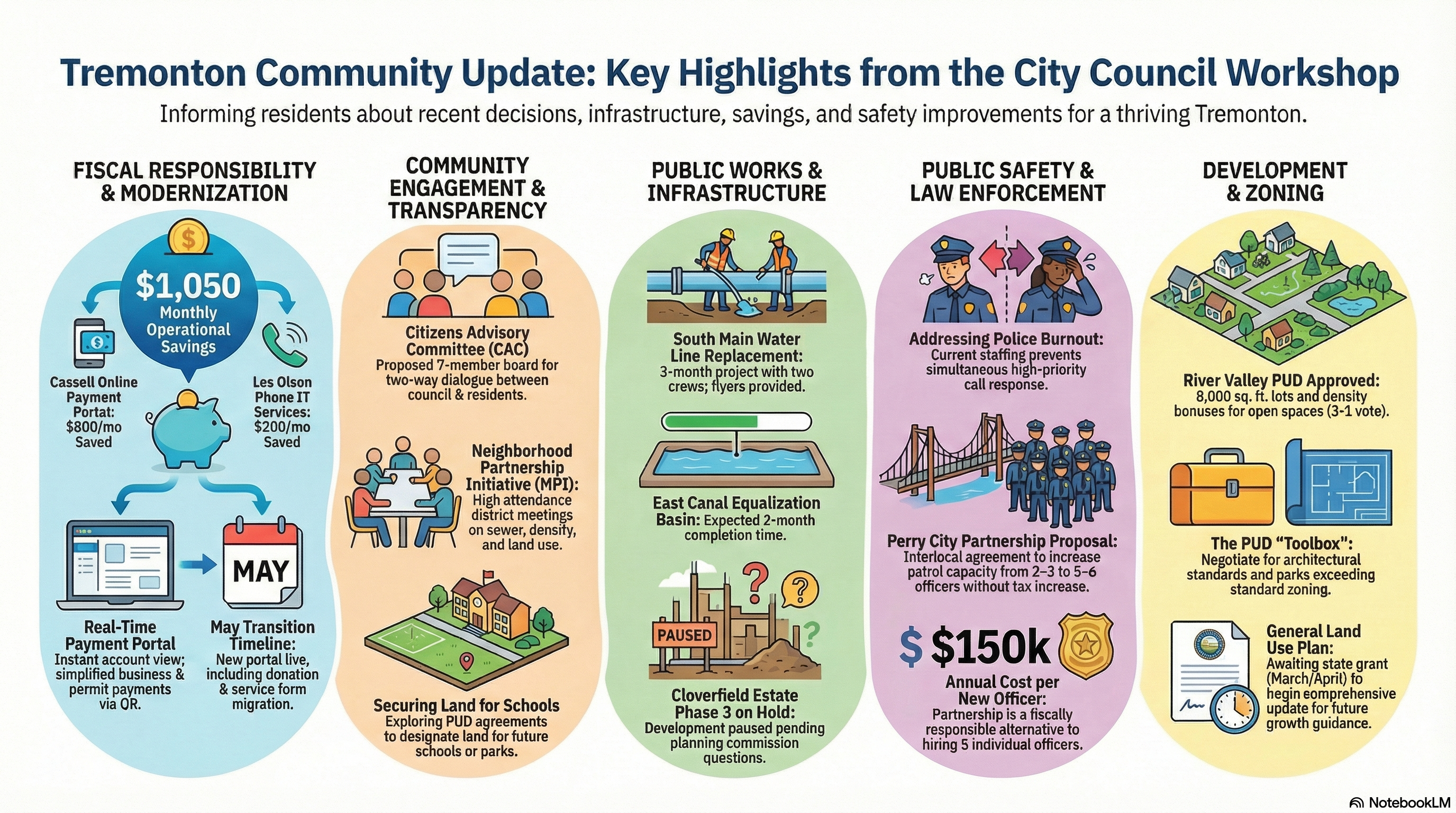
- Neighbors Partnership Initiative (NPI): These groups work with developers and the Planning Commission. They get into the weeds of subdivision designs to make sure new projects respect the “bubble” of your specific neighborhood.
- Citizen Advisory Committee: This group reports directly to the City Council. They are independent of city staff and give us the unfiltered “temperature” of the community on major issues like our General Plan.
If you want to serve, contact the city office or reach out to a Council member. Applications will be on the website soon.

Leave A Comment