
Volume 6, Issue 2 | June 16th, 2026
The Connection Report is a biweekly summary of business conducted in the City Council Workshop and Strategic Planning Session. It reports what was discussed and decided, what is on the calendar, and what items will return to Council for action. This report covers the June 16, 2026 Workshop and Strategic Planning meetings.
Budget Adoption and Financial Review
A large portion of the evening was dedicated to adopting the city budget and taking a close look at the numbers behind it. As Tremonton continues to grow, Council spent time making sure resources are being directed where they are needed most.
Fiscal Year 2026–2027 Budget Adopted
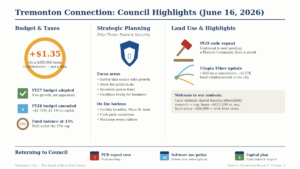
Council adopted Resolution 26-37 approving the city’s budget for Fiscal Year 2027, which begins July 1, 2026 and runs through June 30, 2027. The general fund reflects an overall increase of $59,735 from the tentative budget. Property tax revenue came in at $118,735 in new growth. Council noted that this revenue comes from new growth and development in the community—not from increasing the tax rate or rising home valuations.
Notable items in the new budget include a $30,000 increase to the Box Elder School District school resource officer agreement (the district now pays half of actual wages and benefits for both officers), a $15,465 increase for accounting software and support, $1 million added for the roads department, $2.3 million in road construction projects for 1000 West and Bear River Mountain Road, and a $1.9 million storm drain capital project. The budget also contemplates new software subscriptions, which will not move forward until Council adopts a related use policy at the next meeting.
Fiscal Year 2025–2026 Budget Amended
Council adopted Resolution 26-36 amending the current year budget, an overall general fund increase of roughly $1.78 million. Drivers included higher building and development permit revenue, street lights, railroad maintenance reimbursement, and approximately $113,000 in insurance proceeds tied to the Civic Center roof repair. A portion reflects a transfer of $1.1 million to capital projects and $25,000 to the RDA fund for wayfinding signage.
Staff explained that state guidelines require the city’s fund balance to remain within a specific range. The city ended last year at 33 percent and is projecting an increase of nearly $400,000, which is why these adjustments are being made now.
Financial Statements
Council adopted the April and May 2026 financial statements and warrant registers. Council members thanked staff for the new reporting format, noting it made the figures significantly easier to understand.
Certified Tax Rate
The city’s total valuation rose roughly $46 million, about 4 percent. The certified tax rate is 0.002804. On a home valued at $350,000 that does not change in value, the amount owed would rise about $1.35 over last year; if that home’s value rose with the market, the increase would be closer to $20. This is the rate set through the county’s certification formula, not a tax increase adopted by Council.
| Item | Figure |
|---|---|
| Citywide valuation increase | ~ $46 million (about 4%) |
| Certified tax rate | 0.002804 |
| New-growth property tax revenue | $118,735 |
| Change on a $350,000 home (value flat) | ~ $1.35 more than last year |
Police Budget and Garland Transition
Staff walked Council through the police fund in detail. With the 3 percent cost-of-living adjustment, the fund’s core increase is about 5 percent. The larger figure reflects the transition to provide police service for Garland, which accounts for roughly 18 percentage points of a 23 percent total increase. Garland is paying the city for contracted service, scaled with time, and allowed the city to purchase its police property and assets.
Fraud Risk Assessment
The annual State Auditor fraud risk assessment scored 355, placing the city at a low-risk level. Council discussed whether to establish a formal audit committee, which would add points but is not currently in place.
Strategic Planning — Pillar Three: Connect to Peace and Security
Council continued its strategic planning discussions with Pillar Three: Connect to Peace and Security. This pillar focuses on the things that help residents feel safe, supported, and confident in their community.
Identified challenges included aging facilities, youth safety, scaling public safety services to keep pace with growth, and economic development.
Council discussed positioning the city to attract businesses that bring shoppers in while preserving Tremonton’s rural character. Members noted that prospective employers often look closely at how a city cares for its facilities and public spaces. Early, informal estimates for an exterior facelift of City Hall, police, and fire facilities ran in the range of $250,000 to $275,000. Council agreed any future improvements should align with the Main Street façade grant program and design committee so the look and feel remain consistent across downtown.
Council also discussed an increase in vandalism, particularly in city parks. Members connected this concern with community feedback that highlighted a need for more activities and opportunities for youth engagement.
Council emphasized the importance of strengthening connections between residents and public safety, including continued outreach with the city’s Latino community. School Resource Officers, library programs, and other community partnerships were highlighted as positive examples of building trust and relationships.
Land Use, Planning, and Code Updates
PUD Code Repeal — Continued
Staff brought forward Ordinance 26-05 to repeal Chapter 1.33, the Planned Unit Development overlay code. Staff and the city attorney found the chapter internally contradictory, particularly a provision that could allow bonus density to be granted administratively through the Development Review Committee rather than by the legislative body.
The Planning Commission recommended repeal on a three-to-two vote. Staff is drafting a replacement, a “Planned Community Zone,” that more clearly separates the legislative and administrative steps so that what Council approves is what gets built.
Public Safety and Infrastructure
Trip Hazard and Sidewalk Policy
The city’s insurance carrier requires an official policy for handling trip-and-fall and slip hazard complaints, with adoption required by June 30. Complaints are logged in the iWorks work order system, classified by priority, and tied to GIS mapping, with records retained for three years. Following the program returns the city’s liability premiums. Staff will prioritize repairs along Main Street, then schools, then outward, based on traffic and likelihood of an incident.
Ambulance Write-Offs and Economics
Staff reviewed ambulance write-offs of more than $357,000 accumulated since 2021 and sent to collections, with some amounts still being recovered. Staff reported 881 transports in 2025, about 2.4 per day, with Medicare accounting for roughly 42 percent. Average billing runs about $2,500 per trip with net collections near 50 percent, as Medicare and Medicaid reimburse well below the billed amount. Ambulance rates are set by the state.
Administrative Updates
Council reviewed several personnel and fee items, a number of which needed adoption before July 1. Holiday leave for police and firefighters will move from a twice-yearly grant to a single annual grant on July 1, with unused hours paid out before the new year. Adjustments were made to firefighter vacation carryover, and the city will continue absorbing the next increase in Tier Two public safety retirement contributions so employees are held at their current share.
Council also reviewed Resolution 26-39 amending the fee and fine schedule—including garbage can fees, secondary water billing for new homes already equipped with secondary lines, and cemetery after-hours charges—and Resolution 26-41 applying the 3 percent cost-of-living adjustment to pay ranges.
Council also discussed a challenge many communities are facing: costs continue to rise faster than traditional revenue sources. Rather than putting those conversations off, Council expressed a commitment to having open and honest discussions about economic development and long-term financial sustainability.
The consent agenda—including the June 2, 2026 minutes and Resolutions 26-34, 26-35, 26-38, 26-39, 26-40, 26-41, 26-42, and 26-43—was approved by roll call.
Presentations to Council
Two local students presented research on housing affordability, reporting an average local home price near $425,500 against an average local salary near $46,000, and proposed tools such as accessory dwelling units, density bonuses, and deed restrictions to keep starter homes attainable.
The Bear River Cadet Squadron of the Civil Air Patrol shared information about its youth program for ages 12 to 18, meeting Thursdays in Brigham City.
Utopia Fiber’s executive director and CFO provided their annual update, reporting continued subscriber growth, 1,634 residential subscribers in Tremonton, an anticipated bond reimbursement to the city of approximately $127,000 this year, and estimated household savings of about $29 per month for residents on the network.
Public Comment — Topics Raised by Residents
A resident urged Council not to reduce the police department by a position, citing traffic and road safety, and expressed opposition to high-density housing. The same resident later commented on city building improvements, Main Street, and neighborhood cleanup.
Council received the comments and noted that both public safety staffing and facility improvements remain active topics within the city’s strategic planning and budget discussions.
Returning to Council
The PUD code repeal (Ordinance 26-05) will return for further discussion and possible action at the next meeting. The new use policy tied to the upcoming software subscriptions is also scheduled for the next meeting. Several budget and capital discussions—including allocation of capital project funds and fund-balance targets for each fund—will continue in upcoming sessions.
We encourage residents with questions about their utility bill, the FY27 budget, or any item discussed in this report to reach out to City Hall. We are committed to keeping residents informed and connected as these conversations move forward.
The Connection Report is designed to help residents stay informed about the work happening on their behalf. This report is compiled from the audio record of the June 16, 2026 City Council Workshop and Strategic Planning Session. Official meeting minutes remain the authoritative record of Council action.





Leave A Comment